

Table of Contents
- What Belongs on a Pool Maintenance Checklist for Homeowners
- Daily and Weekly Pool Maintenance Checklist
- Building a Pool Maintenance Schedule That Fits Your Pool
- Pool Water Testing and Chemical Balance: Target Ranges
- Pool Opening and Closing Checklist for the Season
- Troubleshooting Symptoms, Equipment Checks, and Chemical Safety
- When to Hire a Professional Pool Maintenance Service
- Frequently Asked Questions
Last Updated: October 17, 2026
What Belongs on a Pool Maintenance Checklist for Homeowners
A pool maintenance checklist for homeowners is a written list of the cleaning, testing, and equipment checks that keep pool water clear and safe. A checklist removes the guesswork.
The job breaks into four rhythms: daily, weekly, monthly, and seasonal. Most of the effort lands on the weekly tasks. Skip them for two weeks and you’ll spend a weekend fixing the water.
Here’s what most guides get wrong. They list tasks but never say how long each one takes or what to do when the numbers drift. Below, we cover the full routine, the target chemistry ranges, and the fixes when something goes sideways.
The Tools and Supplies You Need Before You Start
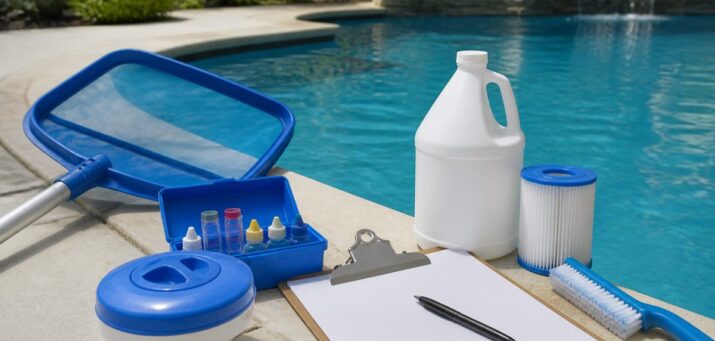
Buy the gear once and the rest gets easy. Here’s the starter kit:
- Long-handled telescoping pole
- Leaf skimmer net
- Wall and tile brush
- Vacuum head and hose
- Two test kits: pH and sanitizer
- Skimmer and pump basket liners
Buy a pole that extends past the deepest end of your pool. A short pole forces you to lean over the edge, and that’s how people fall in.
Daily and Weekly Pool Maintenance Checklist
Daily work takes about five minutes. Weekly work takes 30 to 45 minutes. Together they handle most of what keeps water clear.
Daily tasks:
- Skim the surface with the net
- Empty the skimmer basket
- Check the water level against the tile line
- Glance at the return flow
Weekly tasks:
- Brush walls, steps, and the waterline tile
- Vacuum the floor
- Test pH and sanitizer
- Empty the pump basket
- Check filter pressure
Skimming Surface Debris and Emptying Baskets
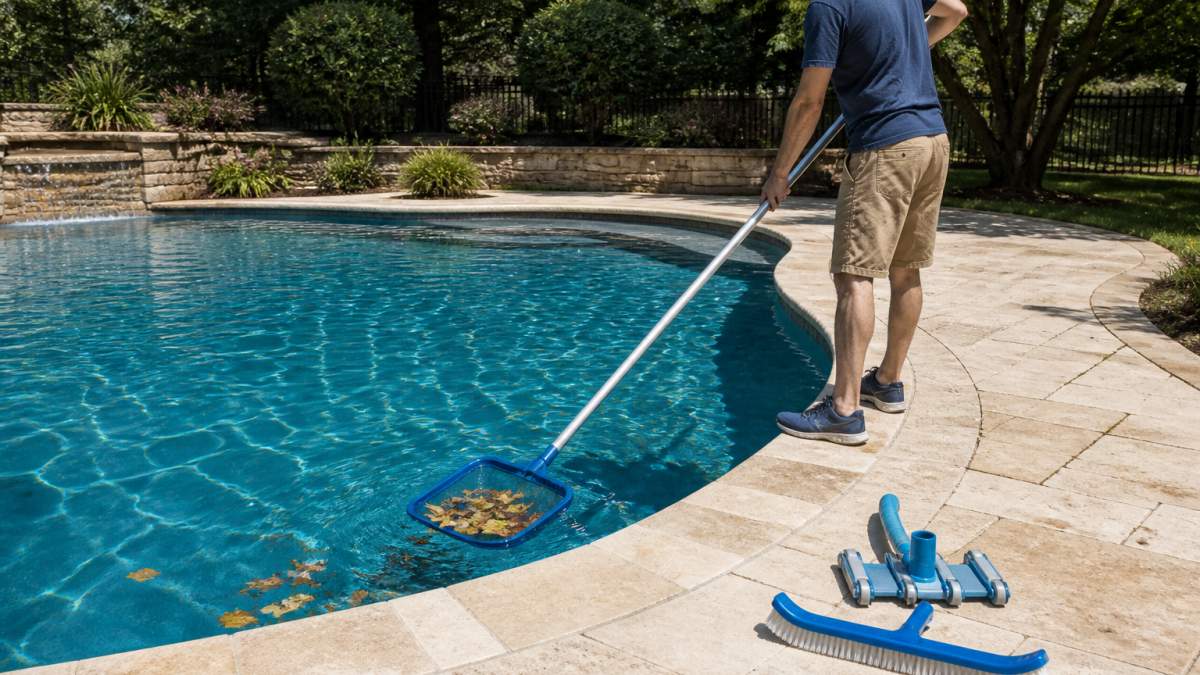
Skim before anything else. Leaves and bugs sink fast, and once they settle they feed algae.
Work the net from the shallow end toward the skimmer. Empty the basket when it’s half full, not when it’s packed. A clogged basket cuts circulation and strains the pump.
Brushing Walls, Steps, and Vacuuming the Pool Floor
Brush first, vacuum second. Brushing lifts film off the walls and steps so the filter can catch it.
Push the brush in overlapping strokes. Hit the waterline tile, the steps, and the corners where algae hides. Then vacuum the floor slowly, or the debris just swirls back up.
Vacuuming too fast stirs up sediment and pushes it back into the water. Move at half the speed you think you need.
Building a Pool Maintenance Schedule That Fits Your Pool
Not every pool needs the same routine. A screened pool in heavy shade collects less debris than one under open trees, and a saltwater system adds a piece of equipment a chlorine pool doesn’t have. The table below shows how to adjust the weekly work.
| Pool Type | Skim | Brush | Vacuum | Test Water |
|---|---|---|---|---|
| Small above-ground | Daily | Weekly | Weekly | 2x per week |
| Gunite, screened | Daily | Weekly | Every 2 weeks | 2x per week |
| Gunite, open to trees | Daily | 2x per week | Weekly | 2x per week |
| Saltwater system | Daily | Weekly | Weekly | 2x per week |
| Vinyl-liner | Daily | Weekly, soft brush | Weekly | 2x per week |
Saltwater pools need one extra check: inspect the cell for scale buildup. Vinyl-liner pools need gentler brushing so you don’t scuff the liner.
The Full Daily-to-Seasonal Rhythm
Most guides stop at weekly. The work actually runs on four clocks, and each one catches what the others miss.
- Daily (about 5 minutes): skim the surface, empty the skimmer basket, check the water level against the tile line, and glance at the return flow.
- Weekly (30 to 45 minutes): brush walls, steps, and waterline tile; vacuum the floor; test pH and sanitizer; empty the pump basket; check filter pressure.
- Monthly (about an hour): clean the filter or backwash it, inspect the pump for leaks or noise, check the skimmer weir and basket for cracks, and test total alkalinity and calcium hardness if you haven’t.
- Seasonal: open and close the pool, deep-clean the filter media, inspect the pump and heater, and review the chemical log for patterns.
Adjusting for Season and Climate
In peak summer, heat and heavy swimmer load push chlorine demand up, so test more often and expect to shock more frequently. In shoulder seasons with less swimming, you can stretch the weekly routine but should still skim and check the water level. In a freeze-prone climate, the closing checklist matters more than any weekly task, a line that freezes and cracks costs far more than a season of testing supplies.
Put the weekly tasks on the same day each week. A fixed day is the difference between a checklist and a good intention.
Time, Tools, and What It Costs to Keep Up
A realistic weekly routine is 30 to 45 minutes, and the monthly deep clean adds about an hour. The tools are a one-time buy: a telescoping pole, skimmer net, brush, vacuum head and hose, and a test kit. Consumables, test reagents, chlorine, acid, and filter media, are the recurring cost, and they climb with pool size and swimmer load. Tracking what you spend for a season tells you whether a service program is cheaper than doing it yourself.
Pool Water Testing and Chemical Balance: Target Ranges
Pool water testing and chemical balance is the part homeowners rush, and it’s the part that matters most. Test at the same time of day, ideally in the morning before swimmers get in, and use a fresh test kit, reagents expire, and a stale kit gives you readings you’ll chase all week.
Here are the ranges most pool care guidance points to:
- pH: 7.4 to 7.6
- Free chlorine: 1 to 3 parts per million
- Combined chlorine: 0.5 parts per million or lower
- Total alkalinity: 80 to 120 parts per million
- Calcium hardness: 200 to 400 parts per million
- Cyanuric acid (stabilizer): 30 to 50 parts per million
Check the CDC guidance on healthy swimming water for the public health side of water quality.
How to Read a Test Result Before You Dose
A single number tells you little. Read the results as a chain, because each reading changes what the next one means.
- High combined chlorine with low free chlorine means chloramines have built up. Shock to break them, not just top off sanitizer.
- pH drifting up every few days usually points to high total alkalinity or aeration from returns and water features. Fix alkalinity first.
- Calcium hardness climbing is often from fill water, not from your dosing. Test your tap water once so you know your starting point.
- Cyanuric acid too high locks up chlorine so it reads present but does little. The only real fix is partial drain and refill.
What to Do When pH or Sanitizer Is Off
Fix alkalinity before pH, and pH before chlorine. Each one shifts the next, so correcting out of order means redoing the work.
- Total alkalinity too low: add sodium bicarbonate per the label
- Total alkalinity too high: add muriatic acid, then aerate to bring pH back up
- pH too high: add muriatic acid per the label
- pH too low: add soda ash
- Chlorine low: shock the pool, then retest
- Chlorine high: stop adding sanitizer and let sunlight burn it off
Retest after four hours. Never dose twice without testing in between, and never add two chemicals at the same moment, give each one time to circulate.
Alkalinity acts as a buffer. If it’s off, pH will swing all week no matter how much you adjust it.
Testing Frequency by Sanitizer Type
A chlorine tablet feeder, a salt cell, and a biguanide system all read differently on a test kit. Chlorine and salt systems should be tested two to three times a week in swim season. Biguanide systems use their own test kit and don’t read on a standard chlorine test, so don’t judge them by chlorine numbers. Whatever the system, log each result with the date, a written log turns a guessing game into a pattern you can actually see.
Pool Opening and Closing Checklist for the Season
Opening and closing are the two days that set up the whole season. A pool opening and closing checklist saves you from a green surprise in spring.
Opening:
- Remove and clean the cover
- Reinstall baskets, ladders, and handrails
- Fill to the proper water level
- Start the pump and check for leaks
- Shock and run the filter 24 hours
- Test and balance
Closing:
- Clean and vacuum thoroughly
- Balance the water
- Lower the level below the skimmer
- Blow out the lines
- Add winter chemicals
- Cover and secure
The Pool & Hot Tub Alliance publishes standards that many builders and service pros follow.
Troubleshooting Symptoms, Equipment Checks, and Chemical Safety
Cloudy water, green water, and weak return flow cover most pool problems. Match the symptom to the fix.
| Symptom | Likely Cause | Fix |
|---|---|---|
| Cloudy water | Low sanitizer or high pH | Shock, then rebalance |
| Green water | Algae bloom | Brush, shock, run filter 24 hours |
| Weak return flow | Clogged basket or filter | Clean baskets, backwash filter |
| Rising filter pressure | Dirty filter | Backwash or replace media |
| Water not clearing | Poor circulation | Check pump and run time |
Chemical safety rules:
- Store chemicals in a cool, dry, ventilated spot
- Never mix chemicals together
- Add chemicals to water, not water to chemicals
- Wear gloves and eye protection
- Keep kids and pets away during dosing
The EPA guidance on household chemical safety covers safe storage and disposal.
When to Hire a Professional Pool Maintenance Service
Hiring out makes sense when the weekly routine keeps slipping. If you travel, work long hours, or the water never quite clears, a service program pays for itself in avoided repairs.
Watch for these signs:
- Water stays cloudy despite testing
- Filter pressure climbs fast after cleaning
- You’ve missed the weekly routine more than once
- Equipment runs loud or cycles oddly
At All About Pools & Spas, our maintenance programs handle the testing, brushing, and equipment checks on a set schedule. As a licensed contractor and Certified Pool Operator, we also catch small equipment problems before they become replacements.
Frequently Asked Questions
What should be on a pool maintenance checklist?
A working pool maintenance checklist covers skimming surface debris, brushing walls and steps, vacuuming the floor, emptying the skimmer and pump baskets, checking water level, and testing water chemistry. Add filter pressure checks and a quick look at the pump and return flow. Group tasks by frequency (daily, weekly, monthly, seasonal) so nothing gets skipped. The checklist should also include pH, sanitizer, alkalinity, and calcium hardness targets, plus corrective actions for when readings drift outside range.
How often should you test pool water?
Test pH and sanitizer two to three times per week during swim season, and daily during heavy use or hot weather. Run a full panel for alkalinity and calcium hardness weekly to monthly. Test before and after adding chemicals, and always after heavy rain. Keep a log of readings so you can spot trends before water clarity drops. If numbers swing widely, test more often until the pool stabilizes.
How often should you clean a pool filter?
Clean or backwash the filter when the pressure gauge reads 8 to 10 PSI above the clean starting pressure. For most pools that lands every two to four weeks in heavy use. Empty skimmer and pump baskets weekly at minimum, more often in fall. A cartridge filter usually needs a deep clean every few months. Skipping filter maintenance raises pump strain and cuts circulation, which shows up as cloudy water.
When should I hire a professional pool maintenance service?
Hire a pro when water chemistry keeps drifting despite testing, when equipment like the pump or filter needs repair, or when travel and work leave no time for weekly tasks. A licensed contractor can also handle seasonal opening and closing, which involves chemical handling and equipment checks that are easy to get wrong. If you want recurring service so weekends stay free, ask for a maintenance program with a clear scope and monthly cost.
Keeping a pool clear takes a routine, not luck. If the weekly checklist keeps falling to the bottom of your list, let All About Pools & Spas take it over. Our team brings licensed expertise, energy-efficient equipment upgrades, and a full maintenance program that fits your pool and your schedule. Get started with All About Pools & Spas and spend your weekends in the water, not cleaning it.