

Quick Summary
To hire a reliable pool builder, verify licenses, insurance, bonding and permits first, then compare itemized bids and read the contract in writing before signing. A trustworthy builder will provide proof of coverage, pull required permits, and answer questions about change orders and timelines directly.
- Check license numbers directly with the issuing state or local licensing board.
- Ask for insurance certificates sent directly to you from the insurer.
- Be wary of any builder who suggests skipping permits.
- Compare bids line by line, not just by bottom-line total.
- Watch allowances and exclusions, which are common sources of budget overruns.
Table of Contents
- Why Hiring the Right Pool Builder Matters More Than the Pool Design
- Step 1: Verify Licenses, Insurance, Bonding, and Permits
- Step 2: Review Local Pool Builder Listings, Ratings, and Customer Reviews
- Compare Pool Builder Quotes Line by Line
- Questions to Ask a Pool Builder Before You Sign
- Pool Construction Contract Checklist: What Must Be in Writing
- Pool Construction Timeline, Delay Factors, and Post-Build Warranty Coverage
- Booking a Free Estimate with All About Pools & Spas
- Frequently Asked Questions
Why Hiring the Right Pool Builder Matters More Than the Pool Design
Last Updated: October 30, 2026
Choosing the right pool builder often matters more than the design you pick. Vetting the professional history of your candidate remains the most effective safeguard against these common pitfalls, as the process of choosing a reliable contractor requires a careful examination of past performance and professional accountability.
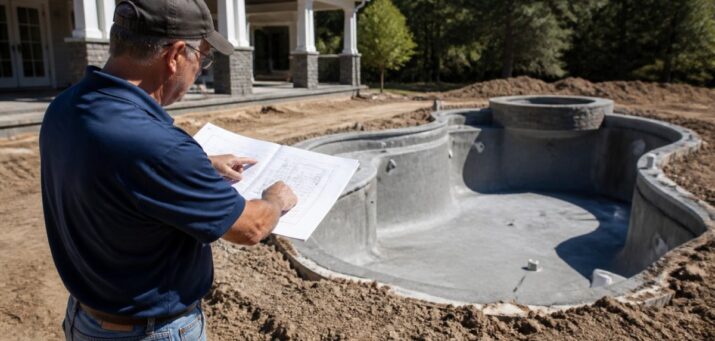
Pool construction is a large, multi-stage project: excavation, plumbing, electrical work, structural shell construction, and finishing. Each stage depends on the one before it, so a builder who cuts corners early can create problems that surface years later.
Vetting a builder before you sign protects you from the most common failures. The steps below cover checking credentials, comparing bids, reading contracts, planning a realistic timeline, and confirming post-build support.
Step 1: Verify Licenses, Insurance, Bonding, and Permits
Start by confirming that the builder holds the licenses required in your area. Ask for license numbers and check them directly with the issuing state or local licensing board, which often publishes searchable databases showing license status and disciplinary history (Check A License).
Next, request proof of general liability insurance and workers’ compensation coverage. Ask the insurer to send a certificate directly to you.
Finally, ask who will pull the building and electrical permits. You can also use U.S. Consumer Product Safety Commission pool safety resources to understand the safety standards inspectors typically check.
Pool equipment choices should also be verified, including whether the builder is authorized to install the manufacturer-backed equipment you select.
Step 2: Review Local Pool Builder Listings, Ratings, and Customer Reviews
Begin with a shortlist drawn from local directories, referrals from neighbors, and the builder’s own website.
Read customer reviews with care. Focus on patterns rather than single comments. Do reviewers mention on-time completion, clear communication, and how problems were resolved?
A high rating based on few reviews carries less weight than a solid rating across many projects over several years. About Us covers the company’s history and service area, which helps you compare builders on a consistent basis.
Ask each shortlisted builder for two or three references from projects completed at least a year ago, so you can see how the surfaces and equipment hold up.
Compare Pool Builder Quotes Line by Line
Getting several quotes is useful only if you compare them carefully. Two bids can look similar on the total and differ widely in what they include, and a lower price may simply mean key items were left out.
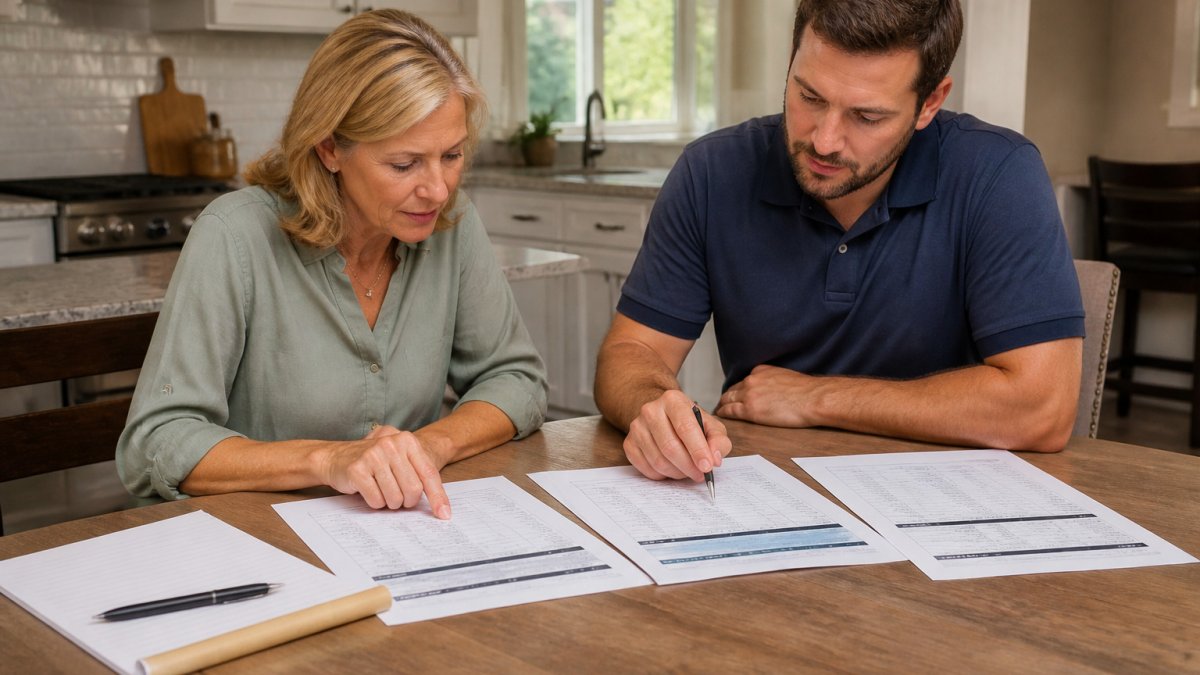
Ask every builder for an itemized bid, not a lump-sum price. A bid you can actually compare breaks the project into line items with quantities, brands, and models.
What a comparable bid should itemize
Line up each quote and check the same categories side by side. At minimum, each bid should show:
- Excavation and site prep, depth, soil haul-off, and whether rock or high-water table contingency is included or extra
- Shell construction, material (shotcrete, gunite, vinyl liner, fiberglass), thickness or wall spec, and rebar or structural detail
- Plumbing, pipe size, number of returns and skimmers, main drain configuration, and valve brands
Allowances: the line item that grows
An allowance is a placeholder dollar amount for a material whose final cost is not yet fixed, commonly tile, coping, decking, or landscaping. Allowances are not automatically bad, but they are the most common source of budget overruns. Compare allowances across bids: a $2,000 tile allowance in one bid and a $6,000 allowance in another can make the totals look closer than they really are.
Exclusions to hunt for
Read the exclusions section as carefully as the inclusions. Common exclusions that surprise homeowners include:
- Rock excavation or dewatering
- Utility relocation or repair of lines hit during digging
- Engineered plans or soil reports
A bid that excludes rock excavation is not necessarily worse, but you need to know it, and you need a stated unit price for it so the change order is not a blank check.
Do not compare bids on the bottom-line total alone. A bid that is $8,000 lower but excludes decking, fencing, and permit fees is not actually lower. Build a simple spreadsheet with the same line items across every bid so the true differences are visible.
Payment schedules and change orders
A large deposit with little tied to actual progress increases your financial risk.
Ask how change orders are priced before you sign. A fair change order states the labor rate, material markup, and any overhead and profit percentage in advance. If the contract is silent on change-order pricing, you have no leverage once work is underway. Get the formula in writing.
A quick scoring method
Once the bids are lined up, score each builder on four things: completeness of the itemized scope, clarity of allowances and exclusions, fairness of the payment schedule, and responsiveness during bidding. The builder who answers questions thoroughly before the contract is often the one who communicates well during construction.
The table below summarises the key line items to compare across builder bids, using only the figures and points covered in this section.
| Bid item | What to check | Why it matters |
|---|---|---|
| Itemized bid | Line items with quantities, brands and models | Lets you compare bids apples to apples |
| Allowances | Placeholder amounts for tile, coping, decking | Most common source of budget overruns |
| Exclusions | Rock excavation, permits, fencing, grading | Lower totals often leave these out |
| Payment schedule | Payments tied to completed milestones | Limits financial risk before work is done |
| Change orders | Labor rate, markup and profit set in advance | Prevents blank-check pricing mid-project |
Questions to Ask a Pool Builder Before You Sign
Prepare a list of direct questions before your meetings. The answers reveal how the builder operates and how they handle problems.
Useful questions include:
- Who will supervise my project day to day, and how can I reach them?
- How many projects are you currently scheduled to work on?
- Which subcontractors do you use, and are they insured?
Pay attention to how directly each question is answered. Clear, specific answers suggest experience. Evasive answers deserve follow-up.
Pool Construction Contract Checklist: What Must Be in Writing
A written contract protects both you and the builder. Verbal promises are hard to enforce, so every important detail belongs in the document. Review the following before signing.
- Full legal business name, license number, and address
- Detailed scope of work, including pool dimensions, shell type, and depth
- Brand and model of every major component
Do not sign until every item is clear. If the builder pushes back on putting details in writing, treat that as useful information about how the project will go.
Pool Construction Timeline, Delay Factors, and Post-Build Warranty Coverage
Realistic timelines help you plan and spot unrealistic promises. Pool projects often take several months from design approval to completion, depending on pool type, site conditions, and permit processing. Ask the builder to break the timeline into phases and explain where delays are most likely, a builder who cannot describe the sequence in phases is guessing.
A typical phase sequence
Most in-ground projects move through a recognizable sequence. Exact durations vary by market and season, but the order is consistent:
- Design and engineering, plan approval, structural engineering, and any soil or survey work
- Permitting, application, plan review, and permit issuance; this is often the longest single wait and is largely outside the builder’s control
- Layout and excavation, staking, digging, and soil haul-off
- Structural shell, rebar, plumbing rough-in, electrical rough-in, and shell application
- Curing, the shell must cure before finish work; rushing this stage causes cracks
- Interior finish and tile, plaster or pebble application, tile, and coping
- Decking and fencing, flatwork, barriers, and equipment pad
- Startup and inspection, equipment commissioning, water balancing, and final inspection
- Punch list and closeout, corrections, cleanup, and warranty documents
Ask each builder for their expected duration for each phase and which phases they control versus which depend on inspectors, utilities, or material lead times.
Delay factors and how to plan for them
Common delay factors include weather, especially heavy rain that affects excavation and shell work, and permit or inspection backlogs. Soil conditions, utility line locations, and material shipping schedules can also slow progress. A good builder plans for these risks rather than ignoring them.
A few mechanisms are worth understanding:
- Inspection scheduling, many jurisdictions require inspections at excavation, rebar, electrical, and final stages. Each inspection is a scheduled event, and a failed inspection adds a re-inspection wait.
- Utility locate and relocation, if a line conflicts with the pool layout, relocation can add weeks and cost.
- Material lead times, equipment, tile, and decking materials can be back-ordered; ask whether the bid locks in lead times or leaves them open.
Ask the builder to state in the contract what happens if the completion date slips for reasons within their control. A delay clause with a defined remedy, even a modest one, tells you how seriously they treat scheduling.
Warranty coverage: what to confirm in writing
Post-build coverage matters just as much as the timeline. Ask how long the structural shell is warranted and what the warranty covers for plumbing, electrical components, equipment, and surface finishes.
Break the warranty question into parts:
- Structure, shell and structural components; ask for the term and whether it is transferable if you sell the home
- Plumbing and electrical, lines and components, and whether the warranty covers labor as well as parts
- Equipment, manufacturer warranties on pumps, filters, heaters, and controllers; confirm the builder passes them through and registers them
Also ask how claims are handled: who you call, the response window, and whether the builder performs the work or subcontracts it.
Ongoing care also affects long-term performance. Pool Design explains how the layout and equipment choices you make today affect future upkeep.
Booking a Free Estimate with All About Pools & Spas
If you are ready to compare a builder against these criteria, All About Pools & Spas invites you to request a free estimate. Our family-owned team has served Sumter, Manning, Dalzell, and nearby communities since 2004.
Visit our main site to request your estimate and start the conversation. Bring your questions from this guide.
Frequently Asked Questions
How do I find a reliable pool builder?
Start with builders who hold a current state contractor license, carry general liability insurance and workers’ compensation, and can show completed residential projects you can visit. Ask for at least three recent customer references and confirm them directly rather than relying only on online ratings. Check whether the company is a member of a recognized trade group and whether its staff hold industry certifications, such as Certified Pool Operator credentials. Local referrals from neighbors who recently built a pool are often the most useful starting point.
How many quotes should I get from pool builders?
Collect at least three written quotes from licensed builders so you can compare scope, materials, and timelines. Quotes that are much lower than the others often leave out equipment, permits, excavation, or decking. Ask each builder to price the same specifications, including pool type such as gunite, vinyl-liner, or fiberglass, equipment brand, and finish. Request a free estimate in writing, and confirm that the price covers the full project rather than a base shell.
What are red flags when hiring a pool contractor?
Watch for requests for large upfront deposits, quotes given without a site visit, unlicensed or uninsured crews, and pressure to sign immediately. Be cautious if the builder cannot name a permit office or will not provide proof of insurance. Vague contracts without a start date, payment schedule, or warranty terms are another warning sign. A contractor who is slow to return calls before the project starts is unlikely to communicate better once work begins.
How long does it take to build a residential pool?
Timelines depend on pool type, site conditions, permit approval, and weather. Vinyl-liner and fiberglass pools typically take less time to install than gunite pools, which require more excavation and curing before finishing. Ask your builder for a written schedule with milestones, and clarify which delays, such as permit holds or rain, may extend the completion date. Good contracts describe how the builder will communicate schedule changes during construction.
