

Table of Contents
- Start With a Site Inspection and Feasibility Check
- How to Verify a Pool Contractor’s License, Insurance, and Track Record
- Questions to Ask a Pool Builder Before You Sign Anything
- How to Compare Pool Contractor Quotes and Spot Exclusions
- Your Pool Contractor Checklist for Contract and Payment Terms
- What a Realistic Pool Construction Timeline Looks Like
- Red Flags and Post-Build Handover: What to Watch For
- Conclusion
- Frequently Asked Questions
Last Updated: October 21, 2026
Start With a Site Inspection and Feasibility Check
Choosing the right pool contractor starts with your yard, not the bids. A pool contractor who walks your property, checks access and drainage, and flags problems early beats one who quotes fast.
What does a real feasibility check cover?
- Access: Can equipment and excavation crews reach the backyard? Narrow gates and steep grades raise costs.
- Utilities and lines: Buried electric, gas, water, and sewer lines may need marking or rerouting.
- Drainage and grade: Water has to flow away from the pool, not into it.
Skipping this step to save time costs far more later. Ask every builder whether the inspection is included or an add-on. If a company quotes without seeing your yard, treat that number as a guess.
Never sign a contract based on a phone quote alone. Site conditions drive much of the cost, and a builder who skips the inspection leaves you exposed to surprise charges mid-project.
How to Verify a Pool Contractor’s License, Insurance, and Track Record
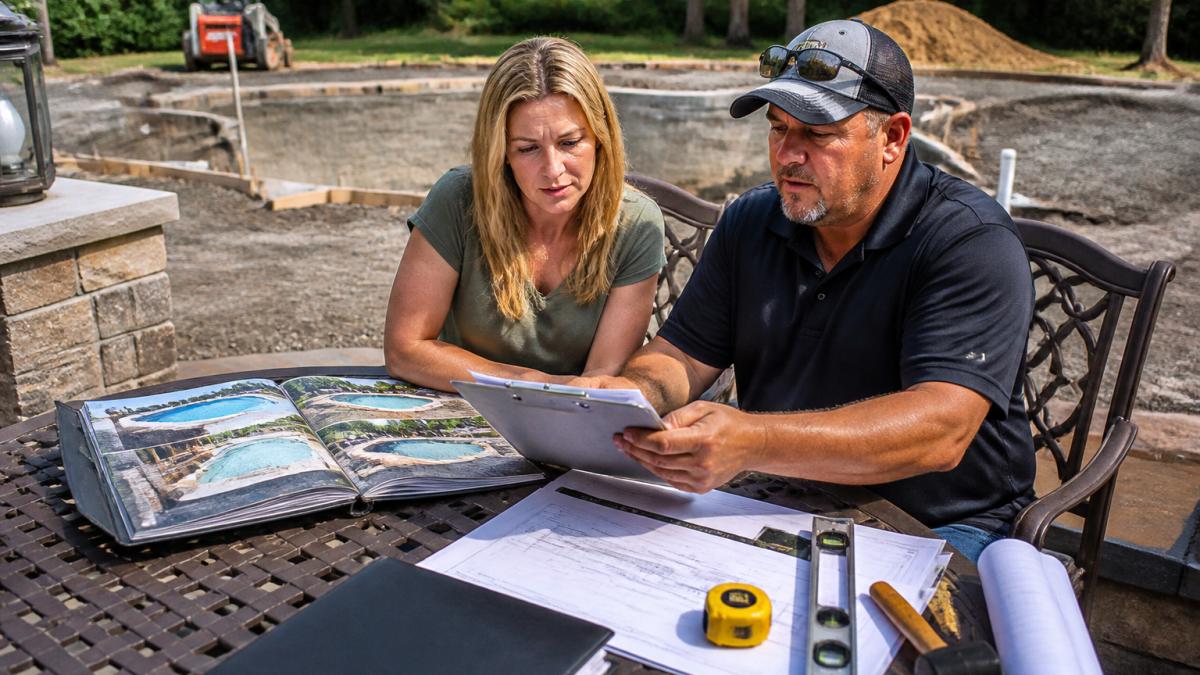
Verification is the step most homeowners rush, and it protects you most. A pool contractor should prove three things on paper: a current license, active insurance, and a checkable track record.
Start with the basics:
- License: Ask for the license number, then confirm it with your state or local licensing board. All About Pools & Spas is a licensed swimming pool contractor, and we expect you to check.
- Insurance: Request a certificate of general liability and workers’ compensation coverage. Call the insurer to confirm it’s current.
- Years in business: Longevity signals stability. A builder who has survived market swings is less likely to vanish mid-build.
- References: Ask for past customers you can actually call. Good builders hand over a list without hesitation.
- Project gallery: Completed projects show the range and quality of their work.
- Online reviews: Read recent reviews for patterns, not just star ratings.
The U.S. Federal Trade Commission consumer guidance is a useful starting point for understanding your rights when hiring contractors.
Questions to Ask a Pool Builder Before You Sign Anything
The right questions to ask a pool builder separate a professional from a salesperson. Ask in person and write down the answers.
- Who will manage my project day to day, and how do I reach them?
- Will you use subcontractors, and are they licensed and insured?
- What’s included in the written estimate, and what isn’t?
A builder who answers vaguely on scope or payment is telling you something. Press for specifics.
Ask each builder the exact same questions and compare answers side by side. Inconsistencies in how they describe scope, timeline, or warranty are your clearest early warning signs.
How to Compare Pool Contractor Quotes and Spot Exclusions
Comparing quotes is where homeowners lose the most money. A lower number often hides missing items, and two similar-looking bids can describe very different pools. To compare pool contractor quotes fairly, normalize every proposal to the same scope before you look at price.
Step 1: Build a scope baseline before you read any bid
Write down what you want first: pool dimensions and depth, shell material, decking square footage and material, coping type, equipment tier, water features, fencing, landscaping, and cleanup. This is your baseline. Map every bid against it line by line. If a proposal doesn’t address a baseline item, mark it excluded, not “probably included.”
Step 2: Read the exclusions page first, not the price
Most pool proposals have a scope-of-work page and an exclusions or “not included” page. Read the exclusions first. Common exclusions that quietly shift cost to you:
- Excavation spoil removal, some bids leave dirt on site or charge hauling separately.
- Rock excavation, a per-hour or per-cubic-yard surcharge if the dig hits rock.
- Decking and coping, sometimes listed as an allowance rather than a fixed scope.
Step 3: Normalize allowances and “or equal” language
An allowance is a placeholder dollar amount for an unfinalized material, tile, decking, or stone. Two bids can carry the same allowance yet produce different final costs if one is unrealistically low. Ask each builder: “What happens if my selections exceed the allowance, and what is the per-unit overage rate?” Do the same for equipment described as “standard” or “or equal”: get the exact brand and model number and compare directly.
Step 4: Score bids on equivalent scope, not headline price
Build a matrix: list every scope line down the side, each builder across the top, and mark Included, Excluded, or Allowance in each cell. Add a column for the dollar value of each exclusion, ask the builder to price it or get an outside quote. The lowest headline number often becomes the most expensive once exclusions are added back; a low base bid padded with change orders is a common pattern.
| What to Check | Why It Matters |
|---|---|
| Excavation and spoil disposal | Some quotes exclude hauling away dirt |
| Rock or soil surcharges | Per-unit charges can appear mid-dig |
| Decking and coping | Easy to leave out or list as a low allowance |
| Equipment brand and model | “Standard equipment” hides cheap parts |
| Electrical and plumbing | Often listed as “by others” |
| Permits and inspections | Who pays and who files? |
| Grading, drainage, restoration | Frequently excluded from base bid |
| Startup chemicals and handover | Confirm it’s included |
Step 5: Ask each builder to explain every exclusion in writing
Before you decide, send each builder the same written question: “Please confirm in writing whether each item on this list is included, and if not, provide your price to add it.” The answers let you compare true totals and show how the builder communicates when the stakes are real. A builder who won’t clarify in writing before the contract is unlikely to document change orders fairly after it.
Compare at least three bids on the same scope matrix. If one bid is dramatically lower, assume it is missing scope until the builder proves otherwise in writing.
Your Pool Contractor Checklist for Contract and Payment Terms
A pool contractor checklist keeps you protected when money changes hands. Read the contract and payment terms closest, that’s where disputes, delays, and lien claims originate. The goal: never pay ahead of work you can see, and never let a promise live only in conversation.
What the written contract should contain
- Full scope of work, including dimensions, materials, equipment brand and model, and finishes
- Explicit list of exclusions and allowances, with overage rates
- Start date, milestone schedule, and completion date (with weather and inspection caveats)
How a milestone payment schedule should work
A reasonable schedule spreads payments across visible progress:
- Deposit at signing, small, typically enough to cover mobilization and permits, not the bulk of the project.
- Excavation and layout complete, payment after the dig and layout are verified.
- Shell and rough plumbing complete, payment after inspection where required.
- Decking and coping complete, payment after the hardscape is in place.
- Equipment set and startup, payment after systems run and water is balanced.
- Final handover, a retainage held until the walkthrough, punch list, and cleanup are complete.
Retainage is the modest percentage held back until the end, your leverage to get punch-list items finished. Ask for it in the contract. Avoid any builder who demands most of the money up front or asks for cash with no contract; that’s one of the clearest warning signs in home improvement.
Lien waivers: the document most homeowners never ask for
A mechanic’s lien lets subcontractors and suppliers claim against your property if they aren’t paid, even if you paid the general contractor. The protection is a lien waiver: at each payment, collect a conditional waiver from the contractor and, where required, from major subcontractors and suppliers, stating they’ve been paid for work through that date. Make it a contract requirement.
Change orders: approve in writing or don’t pay
Change orders are where budgets drift. The contract should state that no change is performed or billed without a written change order signed by you, with a fixed price or stated pricing method. Verbal “we’ll take care of it” arrangements are the most common source of end-of-project disputes. Ask how the builder prices changes, time and materials or a fixed markup, and get that method into the contract before work starts.
Payment mechanics that protect you
- Pay by check or traceable electronic method, never cash.
- Require a written invoice tied to the milestone, with lien waivers attached.
- Keep a simple payment log: date, milestone, amount, waiver received.
USA.gov guidance on home improvement contracts explains why a written contract protects both sides. Get every promise in writing, including verbal assurances about timeline and warranty.
The payment schedule is your strongest protection. Tie every payment to a completed, inspected milestone, collect a lien waiver each time, and never pay ahead of work you can see.
What a Realistic Pool Construction Timeline Looks Like
A clear pool construction timeline helps you plan around disruption and spot delays early. Most residential builds follow the same phases, though timing varies with weather, permits, and site conditions.
- Design and permits: Several weeks, depending on local review times.
- Site prep and excavation: A few days once crews mobilize.
- Shell and plumbing: Roughly one to two weeks.
- Decking and coping: About one to two weeks.
Expect weather and inspection holds to add time. A builder who promises an exact date with no caveats is overselling. Ask for a phase-by-phase schedule and a single point of contact, responsiveness during construction tells you as much as the schedule itself.
Red Flags and Post-Build Handover: What to Watch For
Some warning signs should stop you cold. Watch for:
- Pressure tactics and scare tactics to sign today
- Large cash deposits with no contract
- No verifiable license or insurance
- Vague or missing written estimates
At handover, get a full walkthrough. Confirm equipment operation, water chemistry, and maintenance basics. Ask about aftercare and warranty service. All About Pools & Spas offers maintenance programs and a full-product showroom, so homeowners aren’t left guessing how to care for a new pool. A reliable builder stays reachable after the last invoice.
Conclusion
Hiring well takes patience, but it protects the biggest investment in your backyard. Verify credentials, compare bids line by line, and lock down payment terms before anyone breaks ground.
At All About Pools & Spas, we’ve helped families build and care for pools since 2004. As a licensed contractor with custom gunite, vinyl-liner, and fiberglass expertise, plus ongoing maintenance and a full showroom, we handle the whole project.
Frequently Asked Questions
How do I check a pool contractor’s license and insurance?
Ask for the license number and verify it directly with your state or local licensing authority rather than relying on a business card. Request a certificate of insurance for both general liability and workers’ compensation, and call the insurer to confirm the policy is active and covers pool construction. A legitimate pool contractor will provide these documents without hesitation. If a builder stalls or sends paperwork that doesn’t match the company name on the bid, walk away.
What questions should I ask a pool builder before hiring?
Cover the basics first: how many years in business, who pulls the permits, whether subcontractors or in-house crews do the excavation and gunite work, and who manages the project day to day. Ask for three recent references and one from a project finished at least two years ago so you can hear how the pool has held up. Also ask what happens if weather delays construction, how change orders are priced, and what the warranty covers on the shell, plumbing, and equipment.
How long does it take to build a swimming pool?
Most residential pool builds run eight to sixteen weeks from excavation to handover, though gunite pools with extensive decking, water features, or inspections can stretch longer. Weather, permit timelines, and material availability all affect the schedule. Ask your contractor for a written timeline with milestones and how delays are communicated. A builder who gives a firm date without mentioning weather or inspection contingencies is overselling.
What should I avoid telling a contractor during negotiations?
Don’t reveal your maximum budget or say you’re flexible on price, since that invites padding. Avoid mentioning a hard deadline like a graduation party unless you accept the premium for a rushed schedule. Keep comparisons vague; saying another bid was lower without specifics can push a contractor to cut scope rather than price. Get every promise in writing, including verbal assurances about timelines, equipment brands, and cleanup, because handshake terms rarely survive a dispute.