

Quick Summary
To find reliable custom pool builders, shortlist three to five local contractors with a track record on your pool type, then verify their license, insurance, and subcontractors. Check recent references and compare itemized proposals line by line before you commit.
- Shortlist three to five builders with experience in your pool type, such as gunite, vinyl-liner, or fiberglass.
- Confirm a current contractor license, general liability insurance, and workers’ compensation coverage.
- Ask for three to five references from projects completed within the last few years and call them.
- Compare itemized proposals line by line instead of comparing total prices.
- Put all changes in a written change order signed before the work is performed.
Table of Contents
- Why Finding Reliable Custom Pool Builders Matters Before You Sign
- Shortlisting Custom Pool Builders: Where to Look and What to Check First
- Pool Builder Reviews and References: How to Check What Past Clients Say
- Questions to Ask a Pool Builder Before You Commit
- Custom Pool Construction Cost: Budgets, Cost Drivers, and Contingency Planning
- Pool Builder Contract Checklist: Terms That Protect You
- Booking Your Consultation With a Vetted Builder
- Frequently Asked Questions
Why Finding Reliable Custom Pool Builders Matters Before You Sign
Choosing a custom pool builder is one of the largest and longest-lasting decisions a homeowner in Sumter, Manning, or Dalzell will make. A pool can run from a few months of construction to a lifetime of use, and mistakes in design, permitting, or workmanship are expensive to fix. A well-vetted builder can make the project considerably easier, so it pays to check candidates before the first shovel hits the ground.
The stakes are real. Common frustrations include a contractor who starts strong and then goes quiet for months, or costs that grow well past the original proposal. Both problems often trace back to the initial choice of builder.
This guide walks through how to find a reliable custom pool builder, what to check, and what to put in writing. Our goal is simple: help you hire a builder who finishes on time, communicates clearly, and stands behind the work.
Shortlisting Custom Pool Builders: Where to Look and What to Check First
Start with a short list of three to five builders who work in your area and have a track record with the type of pool you want, whether that is gunite, vinyl-liner, or fiberglass. Local directories, neighbor recommendations, and online review platforms are good starting points. Community forums can surface names, but treat those recommendations as leads to verify, not as proof of quality.
Once you have names, confirm the basics. Check that the builder holds a current contractor license for your state and locality, carries general liability and workers’ compensation insurance, and can name the subcontractors who will handle excavation, plumbing, electrical, and decking. A builder who hesitates on any of these points is telling you something.
Look at completed work, too. A reliable builder can show a portfolio of finished projects similar to yours and let you visit one in person when possible.
Pool Builder Reviews and References: How to Check What Past Clients Say
Online reviews show patterns, but read them carefully. Look for consistent comments about communication, schedule, and how problems were handled, rather than focusing only on the overall star rating. A handful of very recent reviews that all describe the same issue deserves more weight than a single glowing review from years ago.
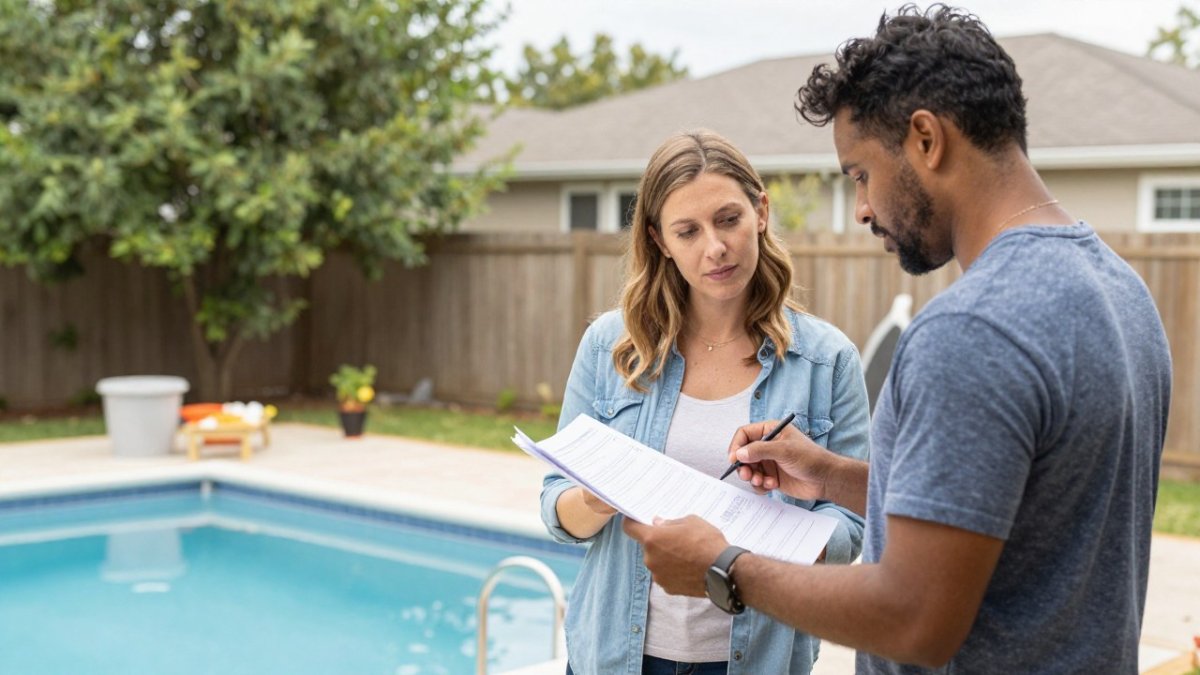
Ask every builder for three to five references from projects completed within the last few years. You can also read what past clients say in our testimonials to see how previous customers describe their experience. Call them and ask specific questions: Did the project finish close to the agreed timeline? Were there unexpected charges? How quickly did the builder respond after the job was done? Would they hire the builder again?
It can also help to ask about older references. A pool that still looks good and works well after several seasons is a useful indicator of workmanship.
Questions to Ask a Pool Builder Before You Commit
A good builder welcomes detailed questions. Use these to compare candidates on equal terms:
- How long have you been building custom pools, and how many have you completed in the last three years?
- Who will supervise my project day to day, and how will I be updated?
- What is your typical timeline from contract signing to completion, and what can delay it?
- Which subcontractors do you use, and are they your employees or independent contractors?
- How do you handle permits and inspections?
- What warranties do you provide on construction, equipment, and the finish?
- Do you offer a maintenance program after construction, and what does it include?
Pay attention to how directly each builder answers. Vague or evasive responses are a warning sign.
Custom Pool Construction Cost: Budgets, Cost Drivers, and Contingency Planning
Cost is the question most homeowners ask first, and the honest answer is that two pools with the same shape and finish can land far apart once site conditions are priced in. Rather than shopping for a single number, build a budget the way an experienced builder does: start with the pool itself, then layer in the site, the surroundings, and a reserve.
The four cost layers. A custom pool estimate is really four budgets stacked together. The first is the pool structure and finish, shell type, size, depth profile, and interior surface. The second is equipment and systems, pump, filter, heater, sanitizer, lighting, and automation. The third is the site work, excavation, grading, drainage, soil handling, and utility relocation. The fourth is the surround, decking, fencing, landscaping, and any outdoor structures.
What moves the number most. In practice, the largest swing factors are rarely the pool finish. They are access and excavation. A narrow side yard that forces smaller equipment, a high water table, rock, or buried utilities can add substantial site work that no brochure price captures.
Compare itemized proposals, not totals. Request a proposal that separates excavation, shell, plumbing, equipment by model number, electrical, decking, fencing, permitting, and startup. Then compare line by line. A lower total often hides a shorter equipment warranty, a thinner deck, or an allowance for finishes that will be upgraded later.
Allowances and exclusions. Many proposals include allowances, a set dollar figure for decking, fencing, or landscaping that gets trued up later. Ask what happens if the actual cost exceeds the allowance and who approves the overage. Read the exclusions list just as carefully; permits, engineering, soil remediation, and final grading are common exclusions that reappear as change orders.
Size the contingency deliberately. Budgeting a contingency reserve for site surprises and elective changes is a sound practice, and the right amount depends on the yard and the scope of work. Keep that reserve separate from your upgrade budget so a soil issue does not quietly consume the spa you wanted.
Payment schedule as a cost signal. A schedule tied to completed milestones, excavation, shell, decking, startup, protects you better than one weighted to the front. Watch out: a builder who asks for a large deposit before permitting or mobilization is shifting risk onto you, and that risk is expensive to unwind.
Finally, budget for the first season of ownership, not just construction. Chemicals, initial water balancing, equipment startup, and any maintenance plan are real costs that belong in your total picture before you sign.
The article breaks a custom pool estimate into four cost layers and names the factors that move the total most.
| Cost layer | What it covers | Note |
|---|---|---|
| Pool structure and finish | Shell type, size, depth profile, interior surface | Core build cost |
| Equipment and systems | Pump, filter, heater, sanitizer, lighting, automation | Compare by model number |
| Site work | Excavation, grading, drainage, soil handling, utility relocation | Often the largest swing factor |
| Surround | Decking, fencing, landscaping, outdoor structures | Often carries allowances |
Pool Builder Contract Checklist: Terms That Protect You
A pool contract is a construction agreement, and the terms that matter most are the ones that decide what happens when something goes wrong. Use the checklist below, but read the explanation beside each item so you know what you are actually negotiating.
- Scope of work tied to the itemized proposal. The contract should reference the proposal line by line, including equipment model numbers and finish selections. A scope that says “standard equipment” gives the builder room to substitute. Ask for the specific models in writing.
- Total price and milestone-based payment schedule. Payments are commonly tied to completed, inspectable milestones such as excavation, shell, rough-in, decking, and startup, with a final payment held until startup and punch-list completion. Watch out: front-loaded schedules that demand most of the money before the shell is finished leave you with little leverage if the project stalls.
- Start date, completion date, and delay remedies. A completion date without a remedy is a suggestion. Ask what happens if the builder misses it, a defined credit, a right to terminate, or both, and carve out excused delays such as weather or permit holds so the remedy is enforceable rather than illusory.
- Permit responsibility and inspection milestones. The contract should state who pulls permits, who schedules inspections, and what happens if an inspection fails. Confirm the licensed contractor named on the permit is the same entity you are paying.
- Change order procedure. Every change should require a written change order signed before the work is performed, stating the price change and any schedule impact. Verbal changes are the most common source of end-of-project disputes. Ask how the builder prices changes, by markup on materials and labor, or by flat fee.
- Warranty terms, separated by component. Construction, finish, equipment, and workmanship often carry different warranty periods and different claim processes. The contract should name who handles each claim, the builder, the equipment manufacturer, or the subcontractor, and the response time. Equipment warranties are often administered by the manufacturer, so confirm who will register them and provide documentation at turnover.
- Insurance and subcontractor disclosure. Ask for a certificate of insurance showing general liability and workers’ compensation coverage, and confirm the policy is current at the time work begins. The contract should identify which trades are subcontractors and confirm the builder is responsible for their work and their insurance.
- Lien waivers and payment documentation. On larger projects, ask how the builder documents that subcontractors and suppliers have been paid. Progress lien waivers tied to each payment protect you from a subcontractor lien on your property.
- Post-construction responsibilities. Startup, water balancing, equipment orientation, and any included maintenance visits should be spelled out, along with who is responsible for the pool during construction and immediately after turnover.
If a term you care about is not written down, it is not guaranteed. Ask for changes in writing, and review the final contract, not just the proposal, before any deposit is paid.
Booking Your Consultation With a Vetted Builder
Once you have a shortlist and have checked licenses, references, and proposals, schedule consultations with your top two or three builders. Bring your questions, your budget range, and a clear idea of how you plan to use the backyard, whether for swimming, family recreation, or entertaining.
At All About Pools & Spas, we are a family-owned and operated contractor serving homeowners in the Sumter area. Our licensed team handles design, construction, renovation, and maintenance, and our full-product showroom lets you see equipment and options in person. Contact us to book a consultation, or review our guide to choosing a pool contractor and our step-by-step hiring process before you reach out. For a deeper look at project costs, see our inground pool cost guide.
Frequently Asked Questions
How much does it cost to make a custom pool?
Custom pool construction cost depends on the pool type, size, shape, materials, site conditions, and features such as spas, lighting, and decking. Gunite, vinyl-liner, and fiberglass pools are priced differently, and access or grading work can add to the total. All About Pools & Spas does not publish set prices, so request a written, itemized quote for your specific yard and compare it line by line with at least two other proposals.
How can I tell if a pool builder is reliable?
Start by confirming the builder holds a current contractor license, carries liability and workers’ compensation insurance, and can name the subcontractors who will do the work. Ask for recent references you can call, look at completed projects in person when possible, and read reviews that describe communication and schedule adherence, not just the final result. A builder who answers these questions directly and in writing is usually easier to trust through a long build.
What questions should I ask a pool contractor before hiring?
Ask how long the builder has been in business, who will supervise your job day to day, and how often you will receive updates. Confirm the expected timeline, how permits and inspections are handled, what the warranty covers, and who services the pool afterward. Ask for a written contract with a payment schedule tied to completed milestones, and request contacts for homeowners whose projects finished on time.
